Nigel Edwards – portfolio


Contact the artist
https://www.nigeledwardsceramicartist.com/
01367 820775
n.edwards0409@btinternet.com
Mobile Number: 07944526824
My website URL: Nigeledwardsceramicartist.com | Oxfordshire
Exhibition information
Bodies of Work:
“Autobiographical Coast” .
“Autobiographical Coast” considers the beauty of the environment where I was raised, using clay bodies and mimetic glazes to convey the raw energy and dynamism of the coast. I have employed various techniques and involved different genres, exploring functional forms through the language of sculpture, to the development of glazes to encourage and engage with thoughts of rural coastlines and marine life. The result is a balance held between two forces, the power of the ocean and man’s relationship and impact on it through geometric and technical interventions.
“Time and Tide”.
My body of work entitled “Time and Tide”, considers the beauty of our coastal environments. Through my creative interpretations; using clay bodies, glazes and pictorial representation, the work conveys the raw energy and dynamism of where sea meets land meets man; at our beautiful coastline. In the work I have employed the language of sculpture combined with mimetic glazes to consider the sea’s relationship of tidal influences created by the phases of the moon.
“Starfield ”.
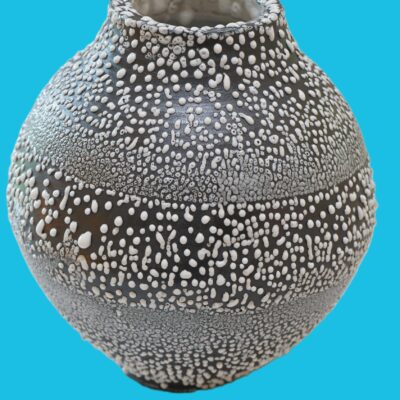
Reflecting on the period of great progressive innovation and growth of the 1950’s, 60’s and 70’s , I have investigated aesthetics and techniques to exhibit a diverse and dynamic mimetic of star fields imparting technology, the space race, and this great period of creative diversity: the 1960’s and 70’s.
I have researched and developed a black slip and “beading” glaze to create this aesthetic, the work’s influences are rooted in this progressive period of modernism with research into the great work of post war Hungarian and West German ceramicists.
“White Horse Terrain: Geographical Identity”
This body of work is less retrospective; drawing inspiration from my contemporary life in the Vale of the White Horse, Oxfordshire.
I have designed and incorporated sprigged and sculpted forms in relief to celebrate the ancient and iconic White Horse at Uffington.
The Vale is the valley of the stream called the Ock, a stream which joins the Thames at Abingdon.
Above the village of Uffington, the gigantic figure of the white horse is cut into the turf of the hillside revealing the white chalky soil beneath. I have lived in a hamlet of the Vale in the shadow of White Horse Hill for over 30 years. Geography, environment, and a sense of place in a rural location are important to me and are qualities inherent in my work.
Epistrophe: Retrospective Ceramic Considerations
Epistrophe is derived from a Greek word; nowadays commonly used in grammar as a rhetorical device of repeating a word, but its original meaning was for turning back not just in a physical sense but the turning of the mind to a spirit to what was once- not simply nostalgia but an awareness of the past like looking over your shoulder at the path that shaped you.
From my perspective it was the important and seminal work of Leach and Hamada of positioning modern ceramic art which led to the inspiration and encouragement of artists of the 1950’s 60’s, and 70’s, such as Shoji Hamada, Bernard Leach, Marion De Trey, Lucie Rie, Hans Coper, Michael Cardew, Bryan Newman and of my friend Harry Juniper.
In this body of work, I intend to revisit, re-explore, consider and acknowledge the great work in ceramics of potters working in the geographical location of where I was born and brought up in Devon.
Artist information
I worked in broadcast television for over 30 years as an editor, director, and independent producer. After retiring in 2015, I returned to fulltime education studying art and ceramics, at Cardiff Met. University where I gained a first-class BA (Hons) in ceramics.
I now live and work at my studio in the small Oxfordshire village of Fernham. I was bought up on the rural coast of Devon during the time of great social, economic, and technical change; the 1950’s 60’s and 70’s.
Geographical Identities:
Coastal geography and my local rural environment are important issues to me, and these themes are always somewhere to be seen in my work
1
Nigel Edwards