
Catherine Rye – portfolio






Contact the artist
https://www.acreativegarden.com
01865 351469
catherinecreativegarden@gmail.com
My YouTube Channel: https://www.youtube.com/@acreativegarden
Meet the artist
The artist at work
Virtual tour
Exhibition information
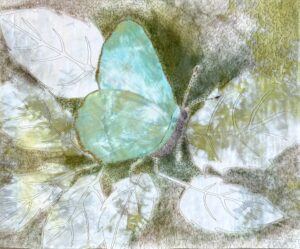
Did you know that the Glanville Fritilliary is the only British butterfly to be named after someone, and that it is a woman – Eleanor Glanville? She lived in the 17th century and had an extraordinary life and is the theme of my exhibition this year. There will be textiles, collages, books and cyanotypes and even a video exploring what it meant for a woman to be interested in natural history at that time and how she was treated after her death.
Artist information
We have always sought to understand the natural world and my work looks at how, as well as observing and appreciating the beauty of nature, we have also tried to classify it. There seems to be a need to define a species of bird, a type of rock or the colour of a flower and to give them names, and the way this was done is also revealing about human nature.
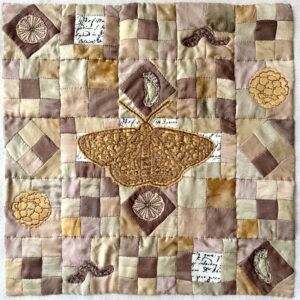
When I made a textile piece on the marbled white butterfly (which is a striking black and white) my research led me to many wonderful colloquial names such as flying chequerboard and half-mourner – the latter referring to how in Victorian times, after full black was worn for deep mourning, it was followed by a period when white could be added.
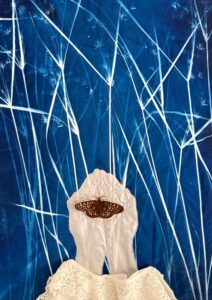
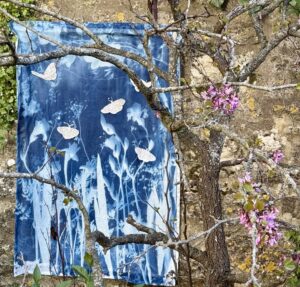
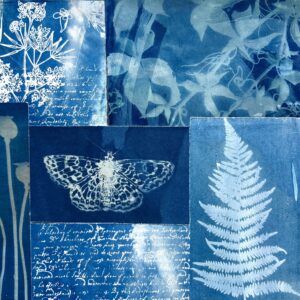
When I print cyanotypes, using the sun to create beautiful shades of blue, I am using the same method that early practitioners like Anna Atkins used at the turn of the 19th century when she captured photograms of seaweed and ferns for scientific knowledge.
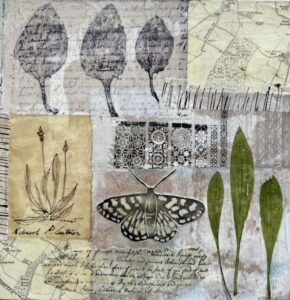
I use a combination of print, stitch and paint on textile and paper to try and depict this world. I like to build up layers on a piece with surface decoration. I might use a screen I made from a letter by a naturalist even if it becomes abstracted to form rather than being legible. I ‘draw’ with my sewing machine to create pattern and detail onto hand dyed fabrics and although I stylise my subjects, I hope that if someone has a look they might recognise the Tissue Moth or a Japanese fern.
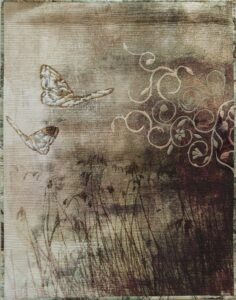
Despite having a chronic illness for many years (thankfully much recovered now) I always managed to garden in some way. That combination of always having plants around me and being at home for much of the time, means that flowers and leaves are a recurring theme. We are lucky to be able to grow such a wide range of species in the UK partly because of the plant hunters who sought out rare specimens, or breeders who created exotic hybrids such as the tulips that famously created a buying frenzy. As well as being inspired by their beauty and history, I also like to use plant material to make monoprints.
I feel everyone deserves to have a flower filled life with both gardening and art and I have a website and YouTube channel both called A Creative Garden that shares methods and inspiration to help achieve this.
45
Cornerstone Arts Centre
